OFFER: A BRAND NEW SERIES AND 2 FREEBIES FOR YOU!
Grab my new series, "Secrets and Courtships of the Regency", and get 2 FREE novels as a gift! Have a look here!
Chapter One
Lady Rosalind Ashbury had been admired before—indeed, pursued, flattered, worshipped, and occasionally feared—because admiration, after all, could be turned. Bent. Used to wound those foolish enough to think beauty a door rather than a wall. But even she had to admit that tonight the ballroom glittered with a particular kind of electricity.
The chandeliers hung low and bright over the Marchioness of Langford’s ballroom, scattering warm golden light over silk, jewels, and feathers. Flowers dripped from pillars, their scent mingling with the faint perfume that clung to every young lady who had spent the better part of the day preparing to be looked at.
Naturally, Rosalind was the dazzling ornament that they were all eyeing over their fans.
She swept into the ballroom on her aunt’s arm, Lady Honoria stiff and bolt-upright as a pike while Rosalind floated beside her, a vision of cool grace in ice-blue silk that hugged her bodice and spilled in soft, shimmering folds to the floor. Her dark curls had been coaxed and pinned by Alice, her dearest friend and lady’s maid, who had tsked over Rosalind’s habit of fidgeting with her hair when bored. Blue ribbons glimmered among her curls like slivers of sky caught in midnight.
Now, as heads turned and whispers followed her progress across the floor, Rosalind lifted her chin. She knew the effect she had. Porcelain skin, sculpted features, full lips—her appearance invited myth, and the ton had obligingly turned her into one. Artemis. Untouchable. Dangerous.
She accepted the title readily enough.
And yet she felt, as she always did. Alone.
Not lonely, precisely. Rosalind would have sooner leaped into the Serpentine than admit to loneliness. But aware, perhaps, of the barrier her own reputation created around her. The young men who surged toward her now—handsome, eager, overdressed—wanted the challenge of winning Artemis, the untouchable huntress. They wanted the right to boast that they had tamed her. They wanted a prize.
None of them wanted her.
That was fine. She didn’t want them either.
“Remember yourself,” her aunt murmured. “The ton does not indulge… excess.”
Rosalind glanced at her with mock innocence. “How dreadful. I had hoped London might prove more entertaining than Ashbury Grange.”
Honoria sniffed. “One does not attend a ball to be entertained.”
Rosalind smiled sweetly. “I beg to differ.”
They had barely paused before the first challenger arrived.
A cluster of gentlemen had already begun circling like peacocks. Rosalind lifted her chin with practiced patience, allowing her expression to carry the faintest warning glint. The boldest of them, Lord Pendrick, stepped forward, his chest puffed like a cockerel.
“My lady,” he began with a bow that nearly toppled a passing footman, “you are resplendent this evening. Might I claim the first dance?”
Rosalind was not listening.
Her gaze had snagged—unexpectedly, sharply—on a solitary figure near the far corner of the room.
He was not preening. Not posturing. Not even attempting to catch anyone’s attention. Instead, he stood partly eclipsed by an ornate column, hands clasped loosely behind his back, observing the ballroom with a quiet, contemplative air completely at odds with the clamoring social frenzy around him.
Dark brown hair, tousled as though he had run a hand through it moments before, fell in soft waves across his brow. His face was more gracefully sculpted than powerfully masculine: high cheekbones, long lashes shadowing deep brown eyes, and a poet’s thoughtful mouth. He was tall, broad-shouldered, but there was nothing of the braggart about him. He carried himself like a man accustomed to strength, yet uninterested in displaying it.
He did not look at her.
That was new.
Rosalind’s lips curved against her will.
Then a surge of dancers and guests swept between them, obscuring him entirely.
She blinked—and he was gone.
“Rosalind?” her aunt’s voice snapped at her with needle-sharp precision. “Lord Pendrick has spoken to you. Do not stand there like a statue.”
Right. Pendrick. She exhaled lightly, the curve of amusement still tugging at her mouth.
“Forgive me,” she said sweetly to Pendrick, though her tone held the unmistakable hint of steel. “I was contemplating whether it is wise to bestow a first dance on a gentleman who cannot execute a bow without endangering bystanders. Perhaps for the safety of the company, we ought to wait until you recover from your near catastrophe.”
Pendrick flushed beet red. “I—that is—unfair—”
“Oh, fairness has nothing at all to do with it. Coordination, however, does.” She flicked her fan open to hide her wickedly demure smile.
A few nearby debutantes tittered behind their fans. A few young men glowered.
Pendrick muttered something unintelligible and retreated, nearly bumping the same footman again.
Rosalind hummed under her breath, pleased.
Lady Honoria exhaled through her nose. “Must you always make sport of them?”
“When they present themselves so willingly? It would be rude not to.”
Honoria pressed her lips so tightly that they whitened.
But Rosalind barely noticed. Her mind flickered back to the man in the corner—the only man in the ballroom not peacocking, preening, or drooling. Not that he had shown interest in her. Not one flicker. He had simply existed, quietly, as though the world’s noise passed around him and left him untouched.
Good heavens. A man immune to spectacle. The novelty of it.
She scanned the ballroom subtly, searching for that tousled head again, but found only the crush of guests.
A trio of young debutantes sashayed past, whispering in voices pitched just high enough to be heard.
“…Ashbury looks so pleased with herself…”
“…as though beauty excuses behavior…”
“…I heard her father hasn’t spoken to her in months…”
“…a pity she cannot behave with any decorum…”
Rosalind pretended not to hear them. She had spent years perfecting that art.
But their whispers snagged in places she pretended were made of marble. She felt the old, familiar ache stir—the one tied to her father’s absence, to her mother’s memory that lived only in others’ inaccuracies, to the reputation she had crafted out of necessity.
If the world would not love me for who I am, then it can fear me instead.
She straightened her shoulders. She would give them something to whisper about.
A rising rustle in the crowd announced the orchestra preparing for the first set. Instantly, Rosalind found herself the target of a dozen invitations. She lifted one gloved hand and pointed with queenly finality at the least irritating of the group—a young viscount whose name she could never remember.
“You,” she said. “Try not to step on my toes.”
The viscount blanched but bowed.
As they took their places, Rosalind felt the weight of observation settle over her like a familiar cloak. She moved flawlessly, her steps precise, her posture impeccable. Her partner attempted conversation with the determination of a man clinging to a script.
“So, Lady Rosalind, I hope you are enjoying the Season. It is, after all, a young lady’s duty to—”
“To surrender herself to the highest bidder?” Rosalind offered lightly.
He sputtered. “To make suitable acquaintances. A woman requires a master, after all. But in the right gentleman’s hands, such guidance is—”
“A kindness?” she finished, eyebrow arching. “I was not aware women were livestock requiring firm handling. But then, perhaps you speak from personal experience?”
The viscount stumbled over his step. Rosalind rolled her eyes skyward.
Men were astonishing.
The set continued, the viscount floundering through his attempts at dominance and decorum.
“You lead with admirable confidence, my lady,” he said stiffly, tightening his grip as they turned.
“I find it prevents collisions,” Rosalind replied.
“A gentleman ought to guide,” he insisted, attempting to correct her step.
“And yet here we are,” she said pleasantly, adjusting him back into place, “with you following and me uninjured. A triumph for us both.” She smiled as sweetly as sin. Each time she turned, skirts whispering around her ankles, she scanned the corners of the room, hoping for another glimpse of the stranger.
Nothing.
By the end of the dance, her partner’s pride was bruised beyond repair. Rosalind gave him a courteous curtsey, the faintest tilt of victory in her eyes. He retreated as though escaping a lion’s den.
And then—finally—she saw him again.
Near the refreshment table this time, engaged in conversation with no one. Simply observing.
Her breath caught.
He lifted his gaze.
Their eyes met.
It was not thunderous. Not overwhelming. Merely… precise. As though some invisible line had been drawn between them and gently pulled taut. Fate clicked into place without the sloppiness of serendipity or the casualness of coincidence.
Just a quiet jolt of something—recognition? Curiosity?—that made Rosalind’s breath catch for a fraction of a moment.
His eyes were gentle, holding no arrogance, no hunger, no expectation. Only a calm, steady… noticing of her. As though he saw not the spectacle, not the goddess, but the woman.
Her heart gave the smallest, traitorous flutter. She masked it by turning away, chin lifted with exaggerated indifference.
Lady Honoria was at her side in an instant. “Your behavior,” her aunt hissed in her ear, “was entirely unacceptable. I warn you, Rosalind, such antics cannot continue. Things may change soon.”
Rosalind met her aunt’s glare with a bright, empty smile. “Change is inevitable, Aunt.”
“Not that sort of change.”
“Oh? A dreadful omen indeed, then.”
“Rosalind. Behave.”
Rosalind’s smile sharpened. “Where would be the fun in that?”
Before Honoria could continue, Rosalind stepped away beneath the pretense of retrieving a refreshment.
She did not want lemonade.
She wanted another look.
She positioned herself near a pillar—strategic, shaded, yet viewable from across the room. Her eyes skimmed the ballroom once more.
He was gone.
Again.
Infuriating man.
“Pity, my lady,” a smooth, too-familiar voice purred at her elbow. “The fellow did not seem half as enchanted as your usual prey.”
Rosalind stiffened.
Lord Adrian Kersey—elegant, smiling, handsome as sin—leaned beside her with his customary, unctuous charm. His dark blond hair gleamed; his impeccable cravat was tied in a style most gentlemen would have deemed excessive. His eyes glittered with the smug malice she knew all too well.
“Adrian,” she said coolly. “I was hoping you would not notice me tonight.”
“Oh, my dear Rosalind, I always notice you.” His smile widened. “All of London notices you.”
“How unfortunate for London.”
He chuckled. “You wound men for sport. I’ve always admired that about you.”
“You admired it until it was your ego I pierced.”
His mouth tightened just enough to satisfy her.
But before he could retort, the crowd stirred with a different kind of whisper—an intrigued hum rolling across the ballroom.
Rosalind followed the shift of heads.
A tall gentleman had just approached the marchioness to offer a bow. His posture straight, dignified but not haughty. His attire elegant but understated. His presence subtle yet unmistakably felt.
Her pulse skipped.
The marchioness beamed at him, gesturing eagerly. A ripple of delighted murmurs followed.
“Who is that?” Rosalind asked under her breath.
Adrian snorted softly. “You truly do not know? The Duke of Ravenshire. Nathaniel Harrow. Recently returned to London after years abroad.”
A duke. Well.
That explained the effortless self-possession.
“That,” Adrian added with an edge of disdain, “is the most tedious man alive. Too gentle. Too thoughtful. Too… noble. You would despise him.”
Rosalind’s lips curled. “How thrilling.”
Before Adrian could respond, a familiar voice—polished, amused—cut in.
“I see Ravenshire has arrived,” drawled Julian Merrick, Earl of Blackwell. He joined Adrian at Rosalind’s side with a rakish grin and a rather splashy bow. “Brace yourselves. The ladies are already preparing to swoon.”
Adrian scoffed. “Heavens spare us.”
Rosalind ignored both of them.
Because Nathaniel Harrow was turning. And for the second time that night, his gaze met hers.
Rosalind’s breath hitched.
His lips quirked—barely, but undeniably.
And then, as though remembering he had manners to uphold, he inclined his head in the faintest, most courteous of acknowledgments.
A bow from across the room.
Directed solely at her.
Heat sparked low in her stomach—unexpected, unwelcome, and far too alive.
“Oh dear,” said Julian cheerfully, watching the exchange. “This should be interesting.”
Adrian’s jaw clenched. “He’ll regret it.”
Rosalind did not bother replying. Her eyes remained on the duke.
Until he turned away, summoned by some eager matron—or perhaps escaping one—and disappeared once more into the mass of swirling colors.
Later—far later—after she had endured three more dances, six more empty compliments, a dozen more jealous stares, and one terrifying moment in which her aunt threatened to confiscate all her fashion plates, Rosalind was finally permitted to leave.
The night air outside the ballroom was blessedly cool. Her coach waited, lanterns flickering softly. Lady Honoria climbed in first, muttering still about decorum and propriety.
Rosalind paused on the step, glancing back at the glowing ballroom windows.
She thought of the whispers.
Of her father.
Of her reputation.
Of her loneliness dressed as arrogance.
And then—inevitably—of the silent duke with soft brown eyes.
She wondered what he would think of her, if he knew her at all.
Not Artemis.
Not the goddess.
Not the spoiled terror of the ton.
Just Rosalind.
She climbed into the coach. Honoria shut the door with brisk disapproval.
“Your behavior tonight,” her aunt continued, “will have consequences.”
Rosalind rested her head against the cushioned wall, gaze drifting to the dark streets of London.
“Everything has consequences, Aunt.”
Honoria frowned. “I mean it. Change is coming.”
Rosalind closed her eyes.
“I know.”
And for the first time in a very long while, she found she was not entirely afraid of it.
Chapter Two
Nathaniel Harrow had always believed that numbers could be tamed with sufficient patience. Columns of figures obeyed rules, at least—more than people ever did—yet even the columns sprawled across his desk were beginning to blur, the ink bleeding together. His study at Ravenshire Hall was quiet at this hour, the late afternoon sun filtering through the tall window behind him, gilding the stacks of correspondence waiting for his attention.
Nathaniel closed his eyes and pressed two fingers to the bridge of his nose.
Another letter from the steward. Another debt from some forgotten cousin of his late father’s. Another list of repairs that could no longer wait. Another discouraging figure detailing how little remained in the estate accounts once duties and wages were paid.
The portrait of his father hung opposite the desk, the former Duke of Ravenshire rendered in oils and arrogance. His expression was stern, his mouth set in a line that suggested perpetual disappointment—whether with the world or with his heir, Nathaniel had never been certain.
“I imagine you find this all very amusing,” Nathaniel muttered toward the portrait, rubbing his temples. “You gambled half of Ravenshire into ruin, and now I must charm what remains of the ton while pretending we are not held together by frayed stitching and prayer.”
The portrait, predictably, offered no reply.
Nathaniel pushed back his chair and rose, long limbs stiff from hours of study. He paced once, then twice, boots whispering over the rug. The familiar scent of leather and old paper usually steadied him. Today it pressed in, heavy with expectation.
A knock sounded at the door—measured, discreet.
“Enter,” Nathaniel called, already suspecting the reason.
Mr. Hayworth stepped inside, silver-haired and impeccable, holding a small silver tray. Upon it lay a folded note, the seal unmistakable.
Nathaniel’s shoulders tightened.
“Your Grace,” Hayworth said gently, inclining his head, “the dowager duchess has sent word again.”
Nathaniel groaned inwardly. Outwardly, he maintained composure. “What is it this time? Another luncheon? A musicale? An urgent desire to host a troupe of traveling musicians despite our inability to pay the last one?”
“Not… quite, Your Grace.”
Hayworth cleared his throat delicately, as though arranging his own words into the most diplomatic shape.
“She is requesting an advance to renew her wardrobe now that the period of mourning has concluded.”
Of course she is.
“An advance?” Nathaniel repeated blandly. “Did she specify how much?”
Hayworth hesitated. That alone was alarming. “Enough,” he said at last, “that I suspect she believes the garment district of Paris is awaiting her personal patronage.”
Nathaniel pressed his fingers against his brow. “Hayworth, I cannot conjure funds out of thin air.”
“Indeed not, Your Grace,” Hayworth murmured. “But the dowager can certainly spend them out of thin air.”
The corner of Nathaniel’s mouth tugged despite himself. “You are becoming bold in your old age.”
“I am becoming practical, Your Grace. If we continue at the current pace, it will not be long before Ravenshire Hall must rent itself to hunting parties or foreign princes seeking a taste of English grandeur.”
Nathaniel stood abruptly, pushing back his chair. “Then I suppose the time has come to confront her directly.”
He collected the message, tucking it into his coat pocket.
“Shall I accompany you?” Hayworth offered.
“No. My mother responds poorly to witnesses.”
“Very good, Your Grace.” Hayworth bowed. “If I may add… be gentle.”
Nathaniel snorted softly and managed a wry smile. “I will be polite, at least.”
Hayworth gave a sympathetic nod as Nathaniel strode from the study.
The walk to the dowager’s private drawing room took him through the long central corridor of Ravenshire Hall, where portraits of long-dead relatives glowered or smirked or stared blankly into the middle distance. Nathaniel suspected the family had produced more scoundrels and gamblers than scholars or statesmen, though he hoped to remedy that reputation.
When he reached the drawing room, he paused, steeling himself, then knocked.
“Come,” his mother’s crisp voice called.
He entered.
Lady Beatrice Harrow sat at her elegantly appointed tea table, draped in deep plum silk—the very gown she had declared “utterly unwearable” during mourning but had nonetheless saved. Her pale blond hair, still impeccably curled despite her age, framed a face of striking beauty marred only by the coldness of her eyes.
A footman hovered nearby, poised with the teapot.
“Nathaniel,” she said with exaggerated sweetness, “how lovely of you to join me. Do sit. You look dreadful.”
“I feel dreadful,” he said, taking the seat opposite her. “You asked for funds.”
Her smile tightened. “Such an inelegant subject.”
“It has become unavoidable.”
“My dear boy,” she said, waving one hand delicately, “I merely informed Hayworth of my needs. He does worry so unnecessarily. I refuse to apologize for maintaining appearances. A duchess must look the part.”
“We cannot afford the part.”
“Nonsense.”
He let out a measured breath. “Mother. The accounts are dire. Ravenshire is… struggling. Repairs are overdue. Debts are piling. We must make cuts—significant ones.”
Lady Beatrice blinked, her lashes fluttering like the wings of a predator disguised as a butterfly. “Cut costs? You sound like a steward. You are a duke. You cannot live like a pauper.”
“We are not paupers,” Nathaniel said calmly. “But we will become such if we do not act responsibly.”
His mother’s eyes hardened. “Your father always managed.”
“No,” Nathaniel said quietly, “he did not. His gambling debts, his reckless entertainments, his—”
She slammed her spoon against her saucer, rattling the china.
“Do not speak ill of him.”
He swallowed the frustration climbing his throat. “I am speaking truth. Someone must.”
Her lips thinned. “What you call truth, I call ungratefulness. Your father adored you. He meant for you to enjoy life. To flourish. Not to bury yourself in bills and ledgers. You are a young man. You should be at balls, making alliances, forming advantageous connections, not lecturing me about pennies.”
“I attend balls,” Nathaniel said, his voice strained despite his attempt at calm, “because you insist I must parade myself before society to secure a wealthy match.”
“Exactly!” She leaned forward, triumphant. “Everything would be resolved if you simply married a young woman of fortune. The right young woman. The right match. Someone whose dowry could—”
“Repair what Father broke?” he finished dryly.
Her cup struck the saucer with a sharp click. “Mind your tone.”
“My tone is restrained,” he replied. “The situation is not.”
Then she smiled. “This would all be resolved,” Lady Beatrice said coolly, “if you married well.” She gestured toward the folded society pages on the table.
Nathaniel tensed. He had learned long ago that when his mother smiled like that, nothing good followed.
“Do not pretend surprise,” she said. “Marriage is duty.”
“Marriage is choice.”
She leaned forward, eyes gleaming. “Marriage is survival.”
He rose abruptly, then forced himself to sit again. “I will not barter my future.”
“You will,” she pointed out, “if you wish to preserve Ravenshire.”
She reached for the society pages laid neatly beside her cup and tapped a manicured finger against one name.
“Lady Rosalind Ashbury.”
His mind flashed unbidden to the moment he had seen her at last night’s ball. The goddess in ice-blue satin. The woman whose dark curls gleamed like polished obsidian under the chandeliers. The woman whose blue eyes had swept the room with icy command. The woman who had caught his gaze—and held it, even for a moment—with a spark he still could not quite name.
He forced his face into neutrality.
“Lady Ashbury,” he said carefully. “Yes, she was in attendance last night. The entire ballroom was discussing her.”
“Of course they were,” his mother said impatiently. “She is the most prolific beauty in London. And, as fate would have it”—here her voice turned bright with greed—“she is wealthy.”
Nathaniel’s jaw tightened. “Mother.”
“Do not take that tone. I am thinking of your future.”
“My future,” he echoed softly, “should not depend on the contents of a dowry.”
“Oh, spare me your virtuous nonsense,” she snapped. “You need an heiress.”
“I need an ethical solution,” Nathaniel countered. “Not a wife chosen for her fortune.”
Lady Beatrice sighed dramatically. “It is not as though I am sending you to woo a troll. The girl looks like a marble statue carved by the gods. All London calls her Artemis.”
“Yes,” he murmured, remembering the icy precision of her posture, the hint of sadness tucked behind her pride. “They do.”
Lady Beatrice leaned closer, eyes gleaming. “And I hear she has a reputation for being difficult. That will suit you. You are too gentle. She will sharpen you.”
He raised a brow. “And her wealth will mend the estate. Is that the heart of the reason?”
Her smile revealed her answer.
Nathaniel exhaled. “Mother. You cannot manipulate my marriage simply—”
“I can,” she interjected, “and I will. Because this family is in tatters, and I will not see us sink into obscurity. Marriage is not a luxury for you—it is a necessity. And Lady Ashbury is both beautiful and wealthy. There is nothing more to discuss.”
“There is everything to discuss,” Nathaniel said quietly.
The dowager rang a bell, dismissing the footman—and clearly dismissing, in her mind, the conversation.
Nathaniel stood. “I will not promise to pursue her.”
“You already caught her attention last night,” Lady Beatrice said smugly. “Half the room saw it, and anyone who missed it surely will find plenty of it here.” She waved a sheaf of the morning’s society papers, and Nathaniel caught glimpses of words: Duke, Goddess, Artemis.
He stiffened. “We merely exchanged glances.”
“Oh, my dear,” she said, pouring herself another cup of tea, “you exchanged far more than that. You exchanged prospects. You will see.”
His jaw clenched.
“Good day, Mother,” he said tightly, and he left before she could respond.
He strode down the hallway, the weight of the conversation heavy in his chest.
Lady Rosalind Ashbury.
Beautiful, yes. Captivating, undeniably. There had been something about her—something sharp and luminous, like lightning caught in glass. But she was also the most notorious young woman in society. Proud. Distant. Untouchable.
The kind of woman who punished men for daring to want her.
A duke with dwindling finances would be the perfect target for her disdain.
He raked a hand through his hair. The thought of approaching her under his mother’s orders made him feel ill.
He wanted a life formed by choice, not desperation. A marriage built on respect or companionship—not a mercenary transaction dressed in silk.
Yet… Ravenshire needed something. Help. Relief. Stability. And perhaps—if he were honest—he needed something, too. Someone who saw him not as the heir to debts or a puppet of his mother, but as a man.
But Lady Rosalind Ashbury was not that someone. She was a glittering enigma, a star too high and cold for earthly matters.
Still… he couldn’t quite forget the way her eyes had sparked when they met his.
A softness beneath the marble. A loneliness that mirrored his own.
He shook himself.
Fanciful thoughts. Dangerous ones.
He needed logic. Solutions. A plan.
But instead, he found himself replaying the brief moment at the ball—the way she had looked at him, not with calculation or expectation, but with curiosity. And something that tangled unexpectedly in his chest.
He reached his study and closed the door behind him.
The numbers still lay scattered across the desk.
He stared at them.
Then he whispered, almost reluctantly:
“Lady Rosalind Ashbury.”
And for the first time that day, the enormity of his predicament settled over him with startling clarity.
He was in trouble.
As the sun disappeared beyond the western hills, Nathaniel found himself unable to concentrate. His mind wandered—to dark curls pinned with sky-blue ribbons, to a sardonic smile, to the way her chin had lifted challenge toward the world.
He imagined approaching her.
He imagined her gaze raking over him like a blade of ice.
He imagined her laughter—cold or warm, he could not guess.
He imagined the friction between them, sharp as flint.
He imagined—
He cut the thought short, inhaling sharply.
This was madness.
He had barely met her. He did not know her. And yet… something about her unsettled him more than any financial crisis ever could.
Not because his mother wanted her to be his salvation.
But because he found himself wanting—if only slightly—to understand someone.
To see what lay behind the goddess mask.
To touch the human heartbeat beneath.
His mother’s plan was a disaster waiting to happen.
But his own heart—traitorous, foolish thing—seemed determined to wander toward danger.
He stood abruptly, crossing the room to the window, pressing a hand against the cool glass.
Below, the grounds spread wide, calm and orderly.
Inside him, nothing felt orderly.
“Artemis,” he murmured, feeling almost heretical.
He wondered how she would look at him if she knew what his mother wanted. With disdain? Interest?
Either way, the spark between them—brief though it had been—had already struck flint.
And Nathaniel, who valued peace above all things, felt a storm building.
He could not imagine stepping out of its path.
Chapter Three
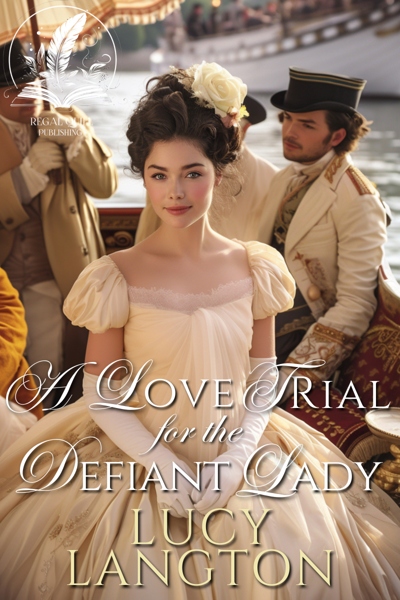
The late-morning sun scattered itself across the river like a thousand mocking diamonds, each glint too bright, too cheerful, too insistent upon joy. Lady Rosalind Ashbury stood at the edge of the landing platform with regal stillness, as though daring the water itself to misbehave in her presence.
Her fingers curled loosely around the ivory handle of her lace parasol—an accessory chosen more for defiance than shade—and her black curls, glossy and abundant, teased free of their pins in the breeze.
Rosalind lifted her chin, surveying Lady Montclair’s water-party with thinly veiled disdain. Pastel silks drifted like petals along the dock. Feathered bonnets bobbed. Gentlemen laughed too loudly and adjusted their coats too often, each hoping to be noticed—by her, if fortune favored them.
She was already bored.
“Alice,” Rosalind murmured without turning her head, “is there anything more tedious than watching grown men attempt to look interesting?”
Her lady’s maid and dearest friend made a delicate choking sound that might have been a laugh—if one dared call Alice’s suppressed bursts of amusement laughter in polite company. “My lady, I am certain at least a few of them are genuinely interesting.”
“Name one.”
Alice pretended to think, though her eyes flickered toward the tall, broad-shouldered figure standing near the end of the dock, speaking with Lord Blackwell. Rosalind followed the direction of her gaze.
Then froze.
There he was.
That man. The one she had tried very hard to forget—and failed.
Nathaniel Harrow. Duke of Ravenshire.
He stood with one hand in his coat pocket, the other lifting slightly as he responded to something Blackwell had said. His voice didn’t reach her, but his profile was a study in clean lines and quiet intensity.
The British sun, weak though it always was, seemed almost to lean toward him. And why shouldn’t it? Men like him probably had celestial bodies rearranging themselves to be near their gravity.
Rosalind scowled.
“I know him,” she said, though the admission felt prickly.
“Do you?” Alice asked, startled. “I do not recall—”
“I do not know him,” Rosalind corrected herself sharply. “I have merely seen him before. Once. He spoke not a word to me.”
Alice blinked. “Isn’t that—good?”
“It is insulting,” Rosalind hissed, refusing to look at the man again even as her pulse quickened, traitorous thing that it was. “No man ignores me. Certainly not at a ball. It was precisely during Lady Montclair’s ball. He danced not once. Not once with anyone. I merely happened to be passing by, and he hardly glanced my way.”
Alice’s eyes twinkled. “And you wish he had?”
Rosalind snapped her parasol shut. “Do not be ridiculous.”
But her stomach had fluttered—fluttered!—the moment her gaze fell on the plane of his cheek, the shape of his mouth, the unconscious strength in his shoulders.
No. Absolutely not. She refused to be taken in by a man. The ones who chased her were beneath her, and now one thought too much of himself to speak or dance with her?
And certainly no such aloof man with the audacity to be attractive.
Aunt Honoria approached just then, her severe gaze sweeping Rosalind from bonnet to slippers as if searching for any hint of rebellion or scandal. Her gray wool gown—always gray, always unadorned—rustled stiffly in the breeze.
“Rosalind, Lady Montclair has arranged the boats by household and rank,” Honoria said, and Rosalind braced herself for the pronouncement. “You will be accompanying the Duke of Ravenshire and his mother.”
Rosalind felt her blood go cold, then hot, then rebelliously cold again. “I beg your pardon?”
Honoria’s expression did not waver. “It is appropriate. You are of similar standing. The duke is unmarried.” She paused. “And you will behave pleasantly.”
Rosalind opened her mouth to object—to argue, to protest the very universe—but Honoria had already turned away, her thin frame marching toward the gathering group of matrons with military precision. Rosalind stared after her, scandalized.
“A duke,” Rosalind muttered, snapping open her parasol again as if the gesture alone could shield her from the humiliation. “Of all the boats, of all the ridiculous pairings, she has thrust me upon him.”
“He is pleasantly handsome,” Alice offered helpfully.
“It is a curse,” Rosalind replied darkly.
Still, she lifted her chin and moved toward the landing. She had been raised to face adversity with poise, after all. And there was nothing more adverse than a man who refused to fall at her feet.
The Duke of Ravenshire turned just as she approached.
His eyes—brown, deep, warm, but curiously unreadable—met hers.
For a single, disorienting moment, Rosalind forgot to breathe.
He bowed, unhurried, a portrait of respect and grace. “Lady Rosalind.” His gaze met hers—and held. Not boldly. Not appreciatively. Merely attentively.
It unsettled her.
She curtsied in return, her reaction far smoother than she felt. “Your Grace.”
Silence expanded between them—heavy, taut, stretched like the delicate skin of a drum ready to snap. Rosalind refused to be the first to look away. She tilted her head, studying him with the full force of her goddess-like scrutiny.
He seemed unaffected. If anything, he looked… calm. Tranquil. Like some philosopher contemplating whether it was worth mentioning that she had a smudge of irritation darkening her brow.
She bristled at his unbothered air even as he spoke.
“I believe we are to share a boat,” His voice was thrillingly low and even.
“I was informed of the arrangement.” Rosalind folded her hands before her, perfectly polite. “It seems neither of us has a choice.”
“Indeed,” he replied, and offered his arm.
She hesitated only long enough to display the hesitation—just a breath, just a flutter of lashes—before placing her fingers against the wool of his coat. His arm was warm. Solid. Infuriatingly reassuring.
She withdrew her hand the moment they stepped aboard the boat.
The vessel was elegantly decorated, Lady Montclair’s taste leaning toward gilded trim and pale blue cushions that were meant to evoke the river’s serenity. Several guests were already aboard, including Lady Beatrice Harrow, the dowager duchess, whose sharp eyes assessed Rosalind with a smile too sweet to be sincere.
“Lady Rosalind,” Lady Beatrice purred. “How lovely you look today.”
Rosalind smiled with equal sweetness. “How kind of you to notice.”
Nathaniel seemed to hold in a sigh as he helped his mother into her seat. Rosalind watched him, pretending she wasn’t—how he guided the dowager with patient hands, how he murmured something discreetly that made Lady Beatrice scowl.
Interesting.
He was dutiful.
She disliked that.
Or perhaps liked it too much.
Rosalind sank into her seat across from him, keeping her posture pristine, her expression impassive.
The boat glided away from the dock.
It became immediately apparent that conversation would be expected.
Lady Beatrice launched into some anecdote about a soirée, which Rosalind endured with a polite smile and occasional nod. But Nathaniel’s gaze—quiet, observant—kept returning to her.
Finally, she met his eyes.
“Is something amiss, Your Grace?”
“No,” he said mildly. “Only wondering whether you enjoy water-parties.”
“I enjoy any event at which I am not forced to listen to inane chatter,” Rosalind replied—sweetly, of course.
“Ah.” His lips twitched, just slightly. “Then I will endeavor not to bore you.”
That should not have startled her. And yet something about the subtle humor in his tone unsettled her, like a pebble tossed into too-still water.
She crossed her ankles, carefully adjusting her skirts. “I do not mind boredom. I merely dislike… mediocrity.”
“A fair preference.”
“Do you have many preferences, Your Grace?”
He considered this, gaze drifting momentarily to the riverbank. “Far fewer than society believes I ought,” he said at last. “But I value sincerity.”
“In people?”
“In everything.”
She blinked. “That sounds—very serious.”
“It is merely honest.”
“And honesty is overrated.” Rosalind cut her gaze from across the water to capture his reaction to her words, and was satisfied with what she saw.
Now he blinked. “Is it?”
“For ladies of my position? Undoubtedly. We are expected to lie constantly. With our smiles, our silences, our obedient nods. It is exhausting, but necessary.” She tilted her chin. “Were I honest even half the time, most of London would have fainted from offense.”
A warmth flickered behind his eyes. “I doubt you give yourself enough credit. I suspect your honesty would be… refreshing.”
The unexpected compliment hit her like heat rising beneath her skin.
She looked away.
Which was absurd. She never looked away.
They reached the gardens set aside for viewing—a curated section of Lady Montclair’s expansive estate, where roses climbed trellises and fountains murmured among marble statues. Other boats were also disembarking, releasing guests into the pathways like brightly dressed birds.
Nathaniel stepped out first, then turned to assist the ladies.
Rosalind was the last to take his hand.
Her fingers fit against his palm too perfectly. She despised that instant awareness—the warmth, the firmness, the unspoken electricity.
His eyes met hers as she descended.
She felt it again. That jolt. That treacherous, breath-stealing awareness.
She released his hand immediately.
They made their obligatory stroll through the gardens, but inevitably, instinctively, they ended up near each other again—close enough that their conversation resumed, though they regarded each other as something more akin to opponents in a duel rather than conversational partners. Each smile and turn of phrase glittered and sliced like a rapier, testing the other’s skill.
“I find this arrangement excessive,” Rosalind remarked, gesturing at the sculpted hedges. “All this fuss simply so wealthy people may gasp at flowers.”
“You do not like flowers?” Nathaniel asked, amusement flickering at the edge of his mouth.
“I like them perfectly well. I simply do not see why we must pretend this is the most exquisite garden in England.” Rosalind frowned as she passed a rose, perfect and scarlet.
“It is widely considered so.”
“And I am widely considered dangerous,” she retorted. “Opinion is rarely truth.”
He glanced at her—really glanced, with something sharper than amusement now. “Dangerous? In what sense?”
“You tell me.”
“I have no wish to presume.” The duke was unflappable, surefooted despite every curve Rosalind volleyed his way.
She arched a brow. “But you did presume I would find sincerity refreshing.”
He exhaled through his nose, the faintest sign of exasperated humor. “You certainly do enjoy baiting people, Lady Rosalind.”
“And you certainly enjoy refusing to be baited.”
Their gazes tangled.
She should have looked away. Instead, her breath hitched.
Nathaniel’s voice dropped a fraction. “I think you enjoy a challenge.”
“Do I?”
“You do now.”
Oh, the audacity.
Heat unspooled low within her belly—disconcerting, unwelcome. She stepped back, needing air.
“You are awfully certain of yourself, Your Grace.”
“I assure you,” he said softly, “I am not.”
Her stomach tightened. She did not like the sensation.
She refused to acknowledge it.
By the time they returned to the boat, Rosalind’s nerves were drawn tighter than harp strings. She stepped in carefully, adjusting herself on the cushioned seat as others boarded.
Nathaniel sat opposite her again.
He folded his hands. Calm. Collected. Perhaps determined to ignore her now.
Good. She hoped he would.
She hoped desperately.
But then his eyes lifted.
Met hers.
Held.
Her breath faltered. She tore her gaze away—and that was when she felt it.
A cold rush beneath her slippers.
She looked down.
Water.
Pooling.
Rising.
“Is something leaking?” she demanded sharply.
Nathaniel followed her gaze—then jolted to his feet.
The boat tilted.
Rosalind shrieked and grabbed the nearest handhold. “What is happening?”
Nathaniel steadied himself. “There is a crack in the hull—we are taking on water.”
Her heart slammed against her ribs. “Fix it!”
“I—cannot fix a crack with my bare hands,” he said in that maddeningly calm voice.
Rosalind shot to her feet. “Then do something!”
“I am doing something. Everyone remain still,” he commanded, turning to the boatman. “Row us to shore. Now.”
Lady Beatrice flapped uselessly. Other passengers clutched hats and parasols. Water sloshed around Rosalind’s ankles.
Rosalind grabbed Nathaniel’s arm with both hands. “If this boat sinks, I shall never forgive you.”
His brows shot up. “This is hardly my doing!”
“Nevertheless!”
He looked genuinely flustered. “I assure you, Lady Rosalind, I have no intention of allowing you to drown.”
The boat lurched, and she fell forward.
Straight into his chest.
His hands caught her waist. Her palms flattened against the firm wall of his coat. Their faces hovered inches apart.
And suddenly—terrifyingly—everything went still.
Except her heartbeat.
Except his breath brushing her cheek.
Except that awareness again, fierce and molten and wholly unwelcome.
His voice was barely above a whisper. “Are you hurt?”
“No,” she breathed—too softly, too honestly.
His fingers tightened just slightly at her waist, and Rosalind felt the breath rush from her lungs once more.
The boatman shouted. The craft jerked forward again.
Nathaniel steadied her, guiding her carefully back to her seat.
Water splashed up her calves.
This was a disaster. A mortifying, soggy, humiliating disaster.
And yet all the thoughts in Rosalind’s mind flowed around something entirely separate from the water. Why does he look at me like that? Why do I care? Why can’t I breathe properly when he is near?
The boat lurched again, tilting dangerously.
“Oh!” was all Rosalind managed to say as she was thrown from the boat. Her skirts grew cold and damp immediately, her parasol lost, but the only thing she noticed was the brown of the duke’s wide eyes, and the flash of his hand reaching out to her, before the cold and dark current closed over her.
OFFER: A BRAND NEW SERIES AND 2 FREEBIES FOR YOU!
Grab my new series, "Secrets and Courtships of the Regency", and get 2 FREE novels as a gift! Have a look here!
Hello there, my dearest readers! I hope you enjoyed this little treat! I will be waiting for your comments here. Thank you 😊